

Mike Macdonald has faced challenges before. He had a defense that was malfunctioning during his first season as head coach in Seattle. His offense was both ineffective and divergent from the identity he wanted. Macdonald established the concept of “chasing edges,” from the moment he arrived in the northwest. The emphasis most take away from the phrase is finding ways to gain an edge over an opponent. Fewer recognize the urgency communicated with the “chasing” portion. Many rookie head coaches would be hesitant to make sweeping changes so soon into his tenure. Not Macdonald. He worked with GM John Schneider to makeover the defense. He parted ways with his offensive coordinator after just one season. Patience is an overrated character trait in leaders. Decisiveness tends to be more valuable. Macdonald has had to balance the two in evaluating what is going wrong with his offense this season. They lost another game for this team. It is time to make some tough decisions about his quarterback and his offensive coordinator. Move too quickly, or too rashly, and he may do irreparable harm to pillars of his program. Move too slowly, and his team will drive right over the edges they are chasing.
Sam Darnold has many Seahawks fans considering the Thelma & Louise route themselves after throwing two more interceptions and making a number of questionable decisions. He did his best to be more decisive in this one with his lowest time to throw of the season (2.72 seconds). That compared favorably to his best games in 2025 (2.66 seconds). Part of the problem was that he was not consistently making good decisions, regardless of how quickly they were being made. There were players open that he was passing up. There were sacks he took that he simply cannot take.
|
LiveSat, Oct 24 · 4 to 6 PM HB LIVE! First Show At Victory Hall With Brady Henderson Victory Hall Our biggest live show yet, with Brady Henderson of ESPN. All ages welcome. Your ticket also gets you to the front of the line at Victory Hall every Seahawks gameday through November. Get tickets |
The issues go well beyond the quarterback. Darnold was throwing quickly. The pass protection was allowing pressure even more quickly (2.59 seconds). There is not a quarterback in history who plays better when under pressure. He was hit a staggering 15 times, and sacked 5 times. That was not even his highest rate of getting hit so far this season.
| Game | Hit rate | Sack rate | |
| 1 | vs. Chargers 2026 Week 4 |
30.8% 8 of 26 |
11.5% 3rd worst |
| 2 | at Broncos 2026 Week 6 |
26.3% 15 of 57 |
8.8% 8th worst |
| T3 | at Steelers 2025 Week 2 |
22.9% 8 of 35 |
5.7% 14th worst |
| T3 | vs. 49ers 2026 Week 5 |
22.9% 8 of 35 |
14.3% Worst |
| 5 | vs. Rams 2025 NFC Championship |
17.5% 7 of 40 |
7.5% 10th worst |
| Hit rate | Sack rate | |
| 2025 regular season 17 starts, 516 dropbacks |
12.2% 63 hits |
5.2% 27 sacks |
| 2025 playoffs 3 starts, 99 dropbacks |
16.2% 16 hits |
6.1% 6 sacks |
| 2026 so far 4 starts, 164 dropbacks |
22.0% 36 hits |
7.9% 13 sacks |
Abe Lucas and Grey Zabel are foundational parts of this offensive line. There was every reason to expect Zabel to accelerate in his second season and push for Pro Bowl, or even All-Pro, recognition given what he demonstrated as a rookie. Lucas had a full season last year and was rock solid. The baseline expectation was he would be at least the same player he was a year ago. Instead, both players have taken significant steps backwards in pass protection.
| Blocker | 2025 | 2026 | Change |
| Abraham Lucas Right tackle | 3.1% 16 of 521 | 7.7% 17 of 220 | +4.6 points |
| Grey Zabel Guard | 3.7% 19 of 513 | 6.4% 14 of 220 | +2.7 points |
| Jalen Sundell Center | 2.4% 9 of 376 | 4.1% 9 of 220 | +1.7 points |
| Charles Cross Left tackle | 4.5% 19 of 418 | 5.5% 12 of 220 | +1.0 points |
| Blocker | 2026 | |
| George Holani Running back | 21.2% 7 of 33 | 2025 backs: 12% to 14% |
| Beau Stephens Guard | 9.9% 7 of 71 | No 2025 pass-pro snaps |
| Christian Haynes Guard | 7.4% 9 of 122 | 13 pass-pro snaps in 2025 |
Part of the reason for confidence in the line play headed into this season was the continuity in both players and coaching staff. Line coach, John Benton, was a key part of what worked so well last year. The expectation was that even a new play caller would be able to lean on what was already working. Very little is working in pass protection right now.
Lucas and Zabel do not appear to be injured. Both struggled in one-versus-one pass rush drills this training camp far more than they had last year. There was some thought it was due to the Seahawks fearsome defensive line getting better. That no longer appears to be the reason.
The results have shifted with who was behind center. Zabel and Cross allowed one pressure between them in the first two games with Lock running the offense. Over the last four, they’ve allowed 25, plus 8 of the 18 hits and sacks charged to the line. Lucas allowed 7 pressures in the first two games. His 6.0% pressure rate since is still about twice his 2025 rate (3.1%), so he’s better but not back.
Whatever the cause, the coaching staff and players need to identify it and address it, or it will not matter who is playing quarterback or who is calling plays.
There is no way to have a conversation about the offensive issues without bringing up the new offensive coordinator. Ten of eleven starters on offense are back with the team this season. Every coach other than the quarterback coach is back. Yes, Kenneth Walker III leaving and Zach Charbonnet being injured are part of the problem (more on that in a bit), but not enough to explain how poorly the offense is performing. Offensive linemen do not regress as pass blockers because the back behind them changes.
What can factor into pass protection is whether the pass plays are resulting in receivers getting open quickly and consistently. We already know Darnold has been taking longer to throw this season. He is also throwing into tighter windows.
| 2025 Regular season |
2025 Playoffs |
2026 So far |
|
There are reasons that quarterbacks throw into tight coverage. Some of those reasons trace back to the player. Ultimately, it is on the coordinator to give his quarterback a good game plan, a good play call, and a proper progression to make the game easier.
It is hard to find a lot of easy throws right now in this offense. Pausing a replay and pointing out open players is misleading. Darnold is likely coached to read through a specific set of progressions. Just because his fourth read is open right away, does not mean he is open a couple seconds later when he reaches that player in the progression.
He is also under pressure so quickly that it is hard to move through progressions or deliver on target throws. Some of his receivers are better at creating separation than others. Most data sources only track separation on plays when the receiver is targeted. One does it on all routes. I have not had a chance to vet the method, but here is a look at how it scored separation heading into this week
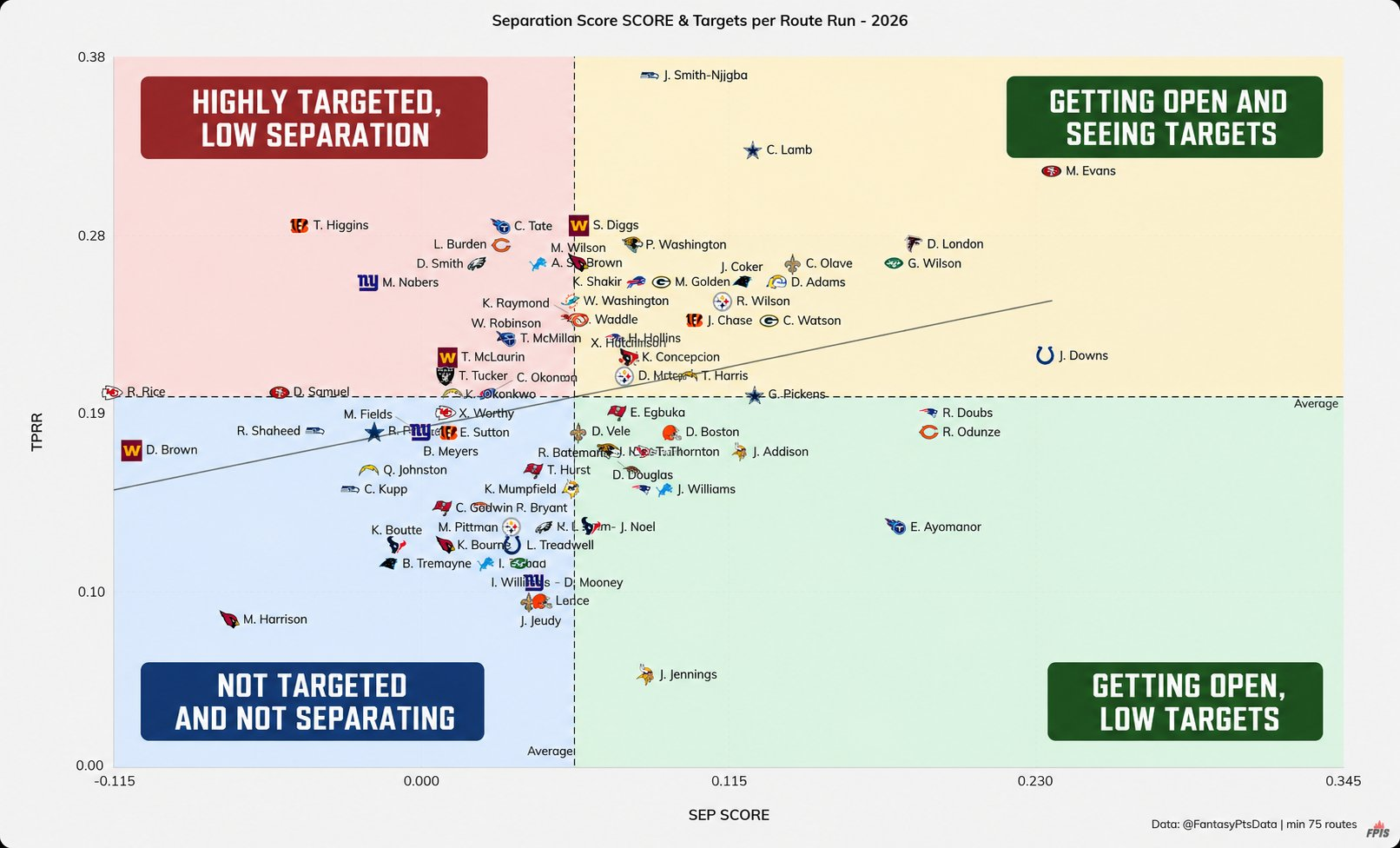
You can see Jaxon Smith-Njigbo doing his thing at the very top. You can also see Rashid Shaheed and Cooper Kupp on the wrong side of the vertical axis. Shaheed has one of the lowest separation scores of any receiver in this sample.
It appears that the coaching staff believes personnel is at least part of the issue. Tory Horton Jr. got his most snaps of the season (39), appearing on 46% of plays. The jump really came after halftime. He played 9 of 30 first-half snaps, about his usual share. Then he played 28 of 52 snaps in the second half and overtime, with 17 of the 28 fourth-quarter plays. Seattle threw 37 times and ran 8 in the second half while trailing 14-3.
He had one catch for 13 yards on a big third down and long. It was one play, but it was also a play you would not see Shaheed or Kupp make. The route was similar to what you would see from Smith-Njigba in terms of separation and elusiveness after the catch. The team should continue to give him opportunities.
The dramatic increase in contested throws cannot fully be laid at the feet of the play caller. Drew Lock registered a contested throw rate of roughly half (10.4%) what Darnold has (19.4%) during his two games. He made fewer tight-window throws as well (16.7% vs 18.4%), although still higher than what the offense saw last season (13.2%).
Fleury is not putting his passers in great situations. The best way to protect your quarterback is to avoid obvious passing situations where defenses can be their most aggressive in coverage and pass rush. Those are also the situations that put the most strain on the offensive line. One way to identify how a play caller is doing in avoiding those obvious passing situations is looking at how successful their 1st down plays are, and how often they turn a 2nd and long (8+ yards) into either a first down or a non-obvious passing situation (4 yards to go or fewer). These charts show Seattle is doing in both regards this season compared to last.
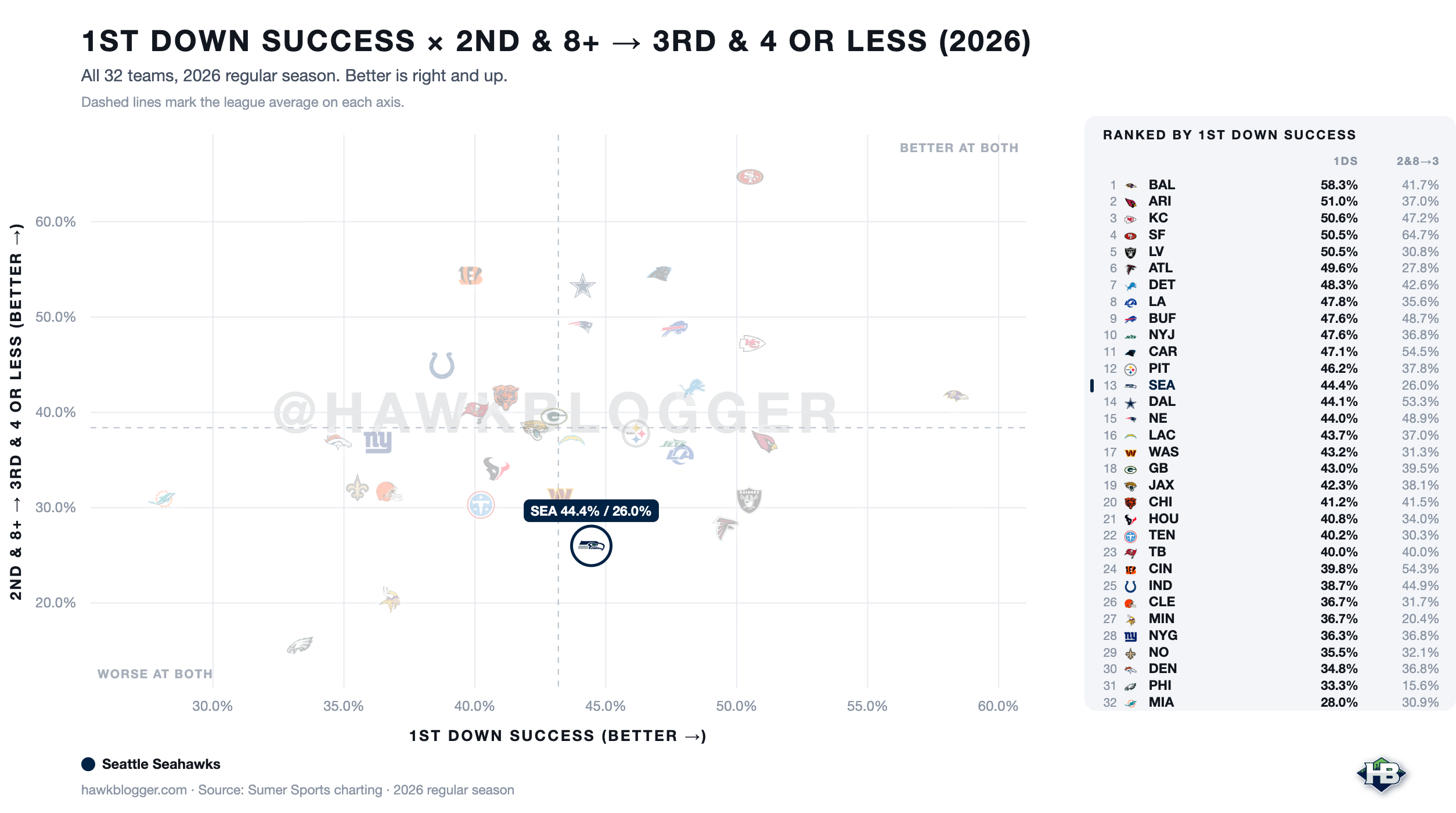
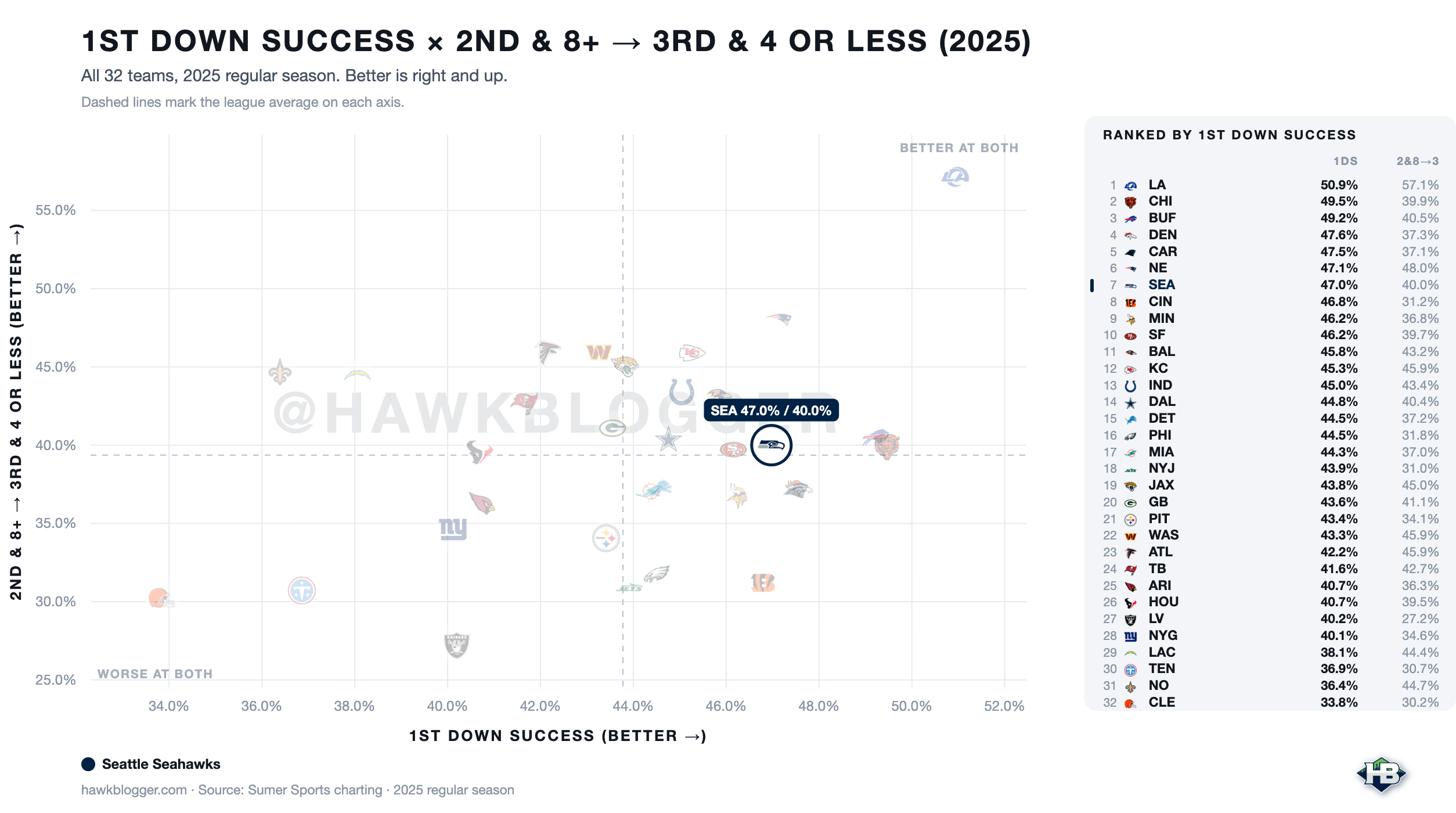
Fleury has done okay on 1st downs (13th). He has had no answers when they get into 2nd and long. The offense ranks 30th in converting 2nd and long into a non-obvious pass situation. That has led to a lot high stress 3rd downs.
The best offenses avoid 3rd down altogether. You can see the faded logo for the Rams in 2025 breaking the chart in the top-right. Part of how Matthew Stafford had an MVP season is both he and his play caller avoided obvious passing situations better than any team by a wide margin. They have fallen back to the back a lot this season, so no play caller and quarterback are perfect.
It should be noted that every 3rd down sack the Seahawks have taken this season has come on 3rd and 5 or more yards to go. His sack rate in those situations has nearly tripled year-over-year (7.4% -> 18.4%). That feels damning of both Darnold for taking the sacks and Fleury for creating too many of those situations.
|
Free every morning Hawk Blogger Daily The last game, the next one, and the numbers that explain both. A Seahawks newsletter from me, in your inbox before your coffee. Sign up free |
Fleury would probably tell you that he would gladly stay out of those situations if he had a running back room that was capable of threatening defenses. Klint Kubiak was great. However, Kubiak benefitted a lot from defenses doing foolish things early last season. They would stack the box with 8+ players even though the Seahawks run game was won of the least effective in the NFL.
Teams finally started to figure this out and the Seahawks pass game plummeted in the second half of the season. It wasn’t until Week 16 that the run game became good enough to punish teams for playing light boxes and leaving more players in coverage. A respectable run game then allowed the pass game to return in the playoffs.
No team respects this run game right now. Denver came into Thursday as one of the league’s most aggressive defenses. Through five games it put 8 or more defenders in the box on 53.9% of designed runs, third most in the NFL. That’s not what Seattle saw. Denver put 8 or more in the box on 20.8% of Seattle’s designed runs. It had six or fewer on 37.5% of them, against 8.5% of runs before. Its average box was 6.79 defenders, against 7.94 before. Both were Denver’s lightest fronts of the season.
Seattle had modest success against these light boxes, but got behind and had to rely more on the pass. There were signs that Fleury is paying attention to what defenses are doing. They had been sending the end to take away the bootleg because they did not respect the running backs. Seattle ran just one bootleg in Denver.
He is a first time play caller, with a quarterback who has some significant long-standing issues, a running back room that ranks among the worst in the league, and some highly paid veteran receivers who are not separating. The reality is this is the way most people expected the Seahawks offense to look last season.
A key difference is nobody was expecting Smith-Njigba to go nuclear, which carried them for many weeks. There is no breakout player on this offense so far. Just players who look broken.
Macdonald is going to have to take all of this information in and make some tough calls. Moving off of Darnold means really committing to Lock. You do not make that move without giving Lock a legitimate shot as the starter. Macdonald has seen far more of both players than any fan or analyst and may be confident that Darnold is the better player, despite the performance to date. There are also repercussions beyond this season.
Darnold is due an extension after this season. He certainly not on track to get it at this point. What happens if Lock comes in and plays just as poorly? What if the problem is the play caller and you burn your starting quarterback along the way?
Coaches are far easier to replace than quarterbacks. Moving on from Fleury this quickly would be a shock. That said, Sean Payton just took play calling duties from his OC after four games. Macdonald may consider shifting play calling duties to another person in-house like Justin Outten with the message of trying to lighten Fleury’s load and letting him catch his breath.
Some have wondered about Jake Peetz, but consider that he has been up for the OC role multiple times with Macdonald and not been chosen. He is also the current QB coach and passing game coordinator, both of which are not performing well at the moment. Outten is an experienced play caller and has ties with the offensive line that could help make the game plans more OL-friendly.
There is no simple path to a good offense on this team. Macdonald needs to keep an eye on his defense, though, as well. Failure to take swift action on offense could lead to that side feeling frustrated and less motivated to put their bodies on the line each week. Make changes that imply the problem is the players and not the coaching staff, and that could create a rift in the connection that has made this locker room so special.
These are rough waters for what is still a very young and relatively inexperienced coach. His track record indicates he will ask the tough questions, have the direct conversations, and make necessary changes. Until then, chase this latest game with your favorite shot, and stay away from edges and ledges.